
11 septembre 2026
From evidence to lasting impact: FID and partners at the SOR4D Research Conference in Bern
Impact
News and Insights
24 October 2025
Publications and resources
Democracy and Governance


Because of its revenue potential, equity, and economic efficiency, property taxation is a cornerstone of local government finance, as well as a key lever for improving the delivery of local public services and strengthening the social contract. Yet, in many low-income countries, revenues from property taxes often amount to only about 10 percent, as a share of GDP, of the levels observed in high-income countries. In recent years, experimental and innovative approaches have emerged to design effective models of property tax reform tailored to the specificities of low-income countries.
Three projects, implemented respectively in Senegal, The Gambia, and the Democratic Republic of the Congo, and supported by the FID, are part of this dynamic. They test innovative and complementary solutions with public authorities, in collaboration with research teams. The results and lessons learned from two of these projects are now available and help inform thinking on tax reform modalities adapted to these contexts.
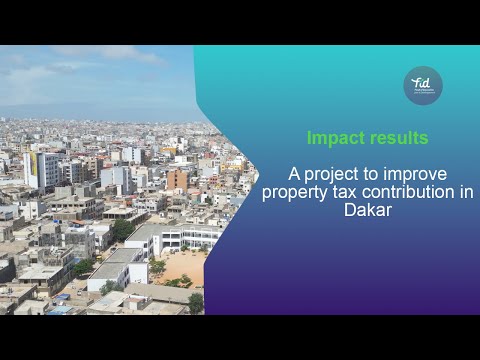
In Senegal, where only 7% of the potential revenue from property tax is collected, the Project for the Improvement of Property Tax Management, led jointly by a research team from the Paris School of Economics, and national tax authorities, in particular the Directorate General of Taxes and Domains, has developed a digital solution to improve the collection process and calculation methods for property tax.
It aims to overcome the structural constraints faced by the Senegalese government, notably: the underexploitation of land registry data, the lack of a reliable address system for delivering tax notices and tracking taxpayers, and certain difficulties in assessing the value of real estate which is then used to calculate tax.
This digital platform has been designed to centralize land registry data and issue tax notices, which authorities can then use to identify taxable real estate on a large scale and update data on taxpayers and their real estate, while ultimately expanding the tax base and making the current system more efficient.
In the Democratic Republic of Congo, the Organization for Economic Studies on Kasai (ODEKA) is leading a project in the city of Kananga, in close collaboration with the provincial tax authority, the Directorate General of Revenue of Kasai-Central (DGRKAC), to answer a central question about tax rates: should the government apply a proportional or progressive rate to maximize tax revenue as well as citizen participation?
This project also aims to assess citizens' perceptions in two key areas: firstly, whether they view the scheme as transparent and fair, and secondly, their willingness to pay taxes. These findings will be used to shape local public policy.
Both of these projects have incorporated research from the start, right from the project design phase. This approach meets a dual objective: validating the effectiveness of innovative solutions under real-world conditions, through rigorous impact assessment, and providing tax authorities with concrete data to guide their reforms.
In Senegal, over 38,000 properties have been added to the tax roll, increasing the registration rate to 92% in the targeted areas. In 2025, 26,412 new tax notices were issued. The new scheme generated over one billion CFA francs in additional revenue and compliance with the local tax system increased three-fold.
Based on these results, the DGID plans to deploy this solution across the entire Dakar region, with potential additional revenue estimated at between 3 and 8 billion CFA francs (€8 to 12 million).
In the Democratic Republic of Congo, a tax collection campaign was conducted in 2024, applying a progressive tax scale in different neighborhoods of Kananga. Tax compliance was found to be five times higher than with other regimes (compared to the existing flat-rate or proportional schemes). Furthermore, the average tax collected per property increased by 36% compared to the existing system.
Although making the current tax system fairer was not the project's main aim, under the new scheme, the most expensive properties are less likely to be undervalued, resulting in more equitable tax payments and limiting revenue losses.
Odeka's study has shown that when the different tax systems are clearly explained, citizens view the progressive tax scale as fairer, which helps build trust in the government and makes them more disposed to pay tax. A study conducted before the project's implementation found that citizens did not see any difference in fairness between the various tax systems. An information campaign was therefore launched to clearly explain the different systems, and assess whether having a better understanding changed taxpayers' perceptions and increased their willingness to pay. This campaign appears to have been successful, as at the end of the project, a majority of taxpayers viewed the progressive system to be the fairest and wanted this scheme to be adopted in Kananga.
Proportional and progressive systems also help instill a sense of civic duty when it comes to paying tax ("tax morale"), especially among wealthy taxpayers, who are more supportive of taxation when the system is fairer.
These results have not only contributed to academic research, they also meet the demand and real need of public decision-makers for evidence-based data to guide their tax policy.
In Senegal and the DRC, authorities are currently considering the wider roll-out of this new property tax scale and collection system.
These initiatives can also provide inspiration for other countries looking to improve tax compliance. The findings from these initiatives in Senegal and the DRC can also be used to inform the other project supported by FID in the Gambia and implemented with the Kanifing local authority.
The Local Government Revenue Initiative (LOGRI) organized a conference in Benin on October 28 and 29, in partnership with the African School of Economics, the Benin Directorate General of Taxation, and the Fund for Innovation in Development, to provide a forum for sharing experience. Tax authorities involved in FID-supported projects took part in discussions with their counterparts facing similar challenges. Estelle Plat, FID representative at the conference, highlighted ‘LOGRI's ability to bring together a large number of experts and decision-makers from both English-speaking and French-speaking African countries to discuss their successes as well as their challenges.’
Link to the website conference for more information : Frontier Issues, Evidence, and Reform Directions: LoGRI Conference 2025 - The Local Government Revenue Initiative

To find out more: - Link to the summary and video recap of the conference, by LOGRI. - Research and publications on property tax issues in developing and emerging countries, centralized by the LOGRI organization - Resources for Democratic Republic of Congo - Resources for Senegal
News
Discover the latest news from FID
Explore FID's news11 septembre 2026
From evidence to lasting impact: FID and partners at the SOR4D Research Conference in Bern

Projects funded by FID
28 juillet 2026
How to prepare inmates for reintegration in Cambodian prisons

Projects funded by FID
13 juillet 2026